Friday, October 15, 2010

Internet Futures for the PRSA


A panel consisting of FRONT Editor Dan Smith (top photo, from left), WDBJ7 Internet News Manager Tracie Gilmer and Roanoke Times Editor Carole Tarrant discussed how the Internet is being used by news organizations at the Blue Ridge Chapter of the Public Relations Society of America's monthly meeting Oct. 14 at the Hotel Roanoke & Conference Center. Thomas Becher of tba (standing left in wide photo) moderated the discussion.

Friday, October 8, 2010

Advance's Credit Upgraded to Investment Grade


Roanoke-based Advance Auto Parts, one of the country’s largest automotive aftermarket retailers of parts, batteries, accessories, and maintenance items, reported today its corporate credit rating has been upgraded to investment-grade (Baa3) status by Moody’s.

In April 2010, Advance Auto Parts was also upgraded to investment grade status (BBB-) by Standard & Poor’s. The company has now achieved full investment grade status.

“We are proud of our upgrade to investment grade status by Moody’s, which builds on our consistent operational performance, strong operating cash flow and solid financial metrics. This upgrade combined with the earlier upgrade by Standard and Poor’s marks a historic milestone for Advance Auto Parts as the Company has achieved full investment grade status,” said Michael A. Norona, executive VP and Chief Financial Officer.

“I would like to thank all of our team members for their contributions toward this achievement. Their efforts combined with our financial progress and strong returns provide us with a solid financial foundation to continue our growth.”

The company has 3,497 stores in 39 states, Puerto Rico, and the Virgin Islands.

Funds Reduction Causes Extension Restructuring

Plans are afoot for a major restructuring of the Virginia Cooperative Extension service. Alan Grant, dean of the College of Agriculture and Life Sciences at Virginia Tech, announced a plan in light of a reduction of $10.3 million funding since 2007 for Virginia Cooperative Extension and the Virginia Agricultural Experiment Station.

The plan was presented to extension faculty and staff during a live Web conference today. “This plan allows Virginia Cooperative Extension to reduce costs, maintain a local presence across the commonwealth, and continue to provide high-quality, science-based educational programming for Virginia. This will allow us to shift resources to the highest-priority needs of the state and localities,” Grant said.

“In addition, the plan will provide local governments the opportunity to customize programming based on the needs of their community.”

According to Grant, the restructuring plan provides an infrastructure that will enable extension to fulfill its land-grant mission and preserve delivery of critical programs related to agriculture and natural resources, youth development, and families and communities.

“The new structure improves Extension’s program delivery model by establishing issue-based program teams that will design educational programs to be delivered to audiences by the locally based field staff,” Grant said. “These teams will be composed of extension educators and specialists, other Virginia Tech and Virginia State University faculty, and other collaborators.”

To ensure effective implementation and delivery of programming in the field, area program leaders will train, supervise, and mentor the Extension educators (formerly known as Extension agents). Area program leaders will have a high level of expertise in a particular subject matter.

The plan consolidates extension’s administrative field staff into a regional structure that includes locally based extension educators clustered around a “business center” in a three- to five-county region. The business center will house support staff as well as one or more state-funded Extension educators who will serve the region.

Each locality will be offered the option of housing one or more extension educators, based on local needs. At least one educator will be funded in partnership with extension and the locality. Localities may elect to fund additional extension educators to work on specific programs.

Thursday, October 7, 2010

Ground Broken for Green Community

Brandon Oaks has become the first retirement community in the Roanoke Valley to be certified as a Cool Green Biz. Ground was broken today for the construction of “The Pines,” Brandon Oaks’ sustainably designed residence, and the retirement community has been certified as a “Cool Green Biz” by the Roanoke Regional Chamber of Commerce. The Pines features the following:
  • It is built on an existing site, leaving more of nature untouched
  • It has energy-efficient HVAC, lighting and appliances
  • It features improved insulation, windows and air filters for lower costs and better health
  • It has water-saving plumbing and systems to decrease run-off
It uses local and low-toxicity materials It features optional rainwater harvesting
Says Executive Director Andy Dickinson, “Not only will residents of The Pines enjoy better, healthier living, they can also take advantage of all the services and amenities that Brandon Oaks offers, including access to our health and vitality center and five-star nursing care.”

In 10 Years, Center Has Had Heavy Economic Impact

The Roanoke Higher Education Center today released an economic impact report highlighting its financial contributions to the regional economy. The study, released at the center’s 10th anniversary celebration, shows an annual stimulus of $32 million in spending and economic development.

“We set out to conduct a study because we wanted to quantify our many contributions to the region,” said Thomas L. McKeon, Ed.D., executive director of the Roanoke Higher Education Center.

“This report shows that the Roanoke Higher Education Center has a major impact on the region, supporting jobs, higher salaries for alumni and local spending. It shows that higher education continues to be a great investment. The results are especially gratifying as we celebrate our 10th anniversary and prepare to serve the future workforce training needs while providing the region with quality, local higher-education choices.”

The report was prepared by the Roanoke Valley-Alleghany Regional Commission to quantify the economic benefits and overall contribution to the region of the center’s annual operation. Commission staff surveyed current students, alumni and institutions to determine the findings.

Highlights from the economic impact report include:

  • The Roanoke Higher Education Center and the operations of its institutional members directly support 103.1 jobs throughout the regional economy. The induced and indirect impacts add an additional 35.4 jobs. The total impact of the center’s operations and those of its institutional members represents a $13.4 million dollar impact on regional sales.
  • Student spending induced through participation at the center’s programs adds an additional $2.3 million and supports roughly 35 service-sector jobs.
  • The survey sought to quantify the increase in personal earnings attributable to completion of one of the center’s academic programs. The spending resulting from increased earnings among alumni who remain in the region contributes an additional $16 million and more than 135 jobs.
  • The total impact is an annual stimulus of nearly $32 million. This activity supports nearly 310 jobs earning an average of $35,142 per year.
“This is quite an impressive impact considering the Center was launched a decade ago, and, along with its members, operates on a $9 million annual budget,” McKeon said.

Wednesday, October 6, 2010

Virginia Tech Ranks 44th in Research Expenditures


Dr. Theresa Reineke with research students at Tech. She is featured as October's Executive Profile in Valley Business FRONT.

With almost $400 million in research expenditures in fiscal year 2009, Virginia Tech is now ranked 44th, according to the just released National Science Foundation (NSF) report based on research expenditures at 697 academic institutions. Virginia Tech ranked 46th in 2008.

The university reported $396.7 million in expenditures for the year ending June 30, 2009, an increase of more than $23 million over 2008. Five years earlier, in 2004, Virginia Tech reported just $268.8 million in expenditures to NSF.

“Perhaps the most significant finding in the new data was our rate of growth compared to other Top 50 programs,” said Robert Walters, vice president for research. “We have grown by an average compounded rate of 8.1 percent per year over the last five years. That ranks us fifth in the rate of growth among those top-tier universities.”

Virginia Tech ranked behind Case Western Reserve (12.38 percent), University of Texas M.D. Anderson Cancer Center (10.39 percent), UNC Chapel Hill (9.16 percent), and Duke University (9.10 percent).

“It is not surprising that the four institutions ahead of us all have premier medical schools given the national priority of funding medical research through the National Institutes of Health (NIH),” said Walters. “We are fortunate that Virginia Tech's leaders began to make NIH funding a priority around 2000, and also that our faculty have risen to the challenge of competing in this arena.”

"The university has also launched an aggressive program of support for strategically important research through the creation of the Research Institutes of Virginia Tech,” said Walters. "During the past year, institutional strategic planning efforts for growth in health and life sciences research culminated in the establishment of the Virginia Tech Carilion Research Institute and the hiring of its founding executive director, Michael Friedlander.

Tuesday, October 5, 2010

Magnets USA Chamber's Small Business of the Year

Business Advocate of the Year Sam English of CIE Partners is interviewed by Lynda McNutt Foster of Wheeler Broadcasting.^
Alan Turner accepted the award as Small Business of the Year for Magnets USA.^

Magnets USA is the overall winner as Small Business of the Year.^

Magnets USA of Roanoke has been named the Roanoke Regional Chamber of Commerce Small Business of the Year. The producer and seller of quality marketing and promotional magnet products was recognized at the Chamber’s 24th Annual Small Business Awards dinner held October 5 at The Hotel Roanoke & Conference Center with an attendance of nearly 550.

The annual awards showcase the accomplishments of the small business sector which is composed of 99 percent of the area’s business community.

In just 20 years, Magnets USA has grown from a one-person operation to a staff of 60 employees who produce and sell marketing and promotional magnetic products from business card magnets to padded calendars. From its beginnings, Magnets USA has grown to become the major promotional magnet supplier for the real estate industry, as well as serving many other small businesses.

Award winners by category are:

Small Business Advocate:
Sam English, partner, CIE Partners (Valley Business FRONT editor and co-founder Dan Smith was nominated for the sixth time in this category. He insists he is "the Susan Lucci of Business Advocacy).

Small Business Veteran of the Year:
Dr. Garrett Thompson, Thompson Family Chiropractic

Construction/Real Estate:
Breakell Inc. has continued to grow and prosper in economically challenging times while being a leader in the “green” construction initiative.

Manufacturing:
The Mennel Milling Company of Virginia is the largest processer of Virginian grown wheat in the Commonwealth.

Micro-Business:
All Star Impressions is the premier recognition awards provider in Southwest Virginia with one-of-a-kind awards, gifts, signs and custom-designed pieces.

Technology: HyperGen Inc. provides customized and specialized IT services and software solutions to clients throughout the nation.

Business-to-Business Services:
Magnets USA.

Business-to-Consumer Services:
SERVPRO of Roanoke, Montgomery & Pulaski Counties provides specialty cleaning services, such as fire and water clean-up and restoration.

Wholesale/Retail:
chocolatepaper is the ultimate indulgence of nectar and pulp, selling gourmet chocolates, distinctive greeting cards, and gifts at its two Roanoke locations.

Legacy Award:
Lanford Brothers Company has operated as a general contractor specializing in highway and industrial asset maintenance for the past 50 years.

Not-For-Profit Arts & Culture:
Virginia Museum of Transportation celebrates and preserves the hard work and ingenuity of the transportation industry.

Not-For-Profit Health & Human Services:
The Rescue Mission of Roanoke has extended a helping hand by offering emergency shelter, meals, a free clinic, and educational assistance to the homeless for over six decades.

Previous small business of the year winners include Home Instead Senior Care (2009), Virginia Prosthetics (2008), Luna Innovations (2007), Blue Ridge Medical Imaging (2006), Plastics One (2005), Virginia Furniture Market (2004), and R & K Engineering (2003). The Roanoke Regional Chamber of Commerce, established in 1889, has more than 1,200 member firms. The Chamber serves its members with advocacy, networking, information, and business assistance programs that maintain a strong business climate in the Greater Roanoke Region.

Tuesday, September 28, 2010

Tech Study Finds Vets 'Slipping Through the Cracks'

A recent panel discussing the findings included (from left): From the Virginia is for Heroes Conference in Richmond this past February, panelists are, from left to right, Shannon Maxwell; retired Lt. Col. Tim Maxwell; Martha Mead of the Virginia Wounded Warrior Program; Mike Rindorf of the Virginia Wounded Warrior Program; Holly Rindorf; and Lt. Eric Malmstrom.


A Virginia Tech-led survey of 2,000 Virginia veterans has revealed that U.S. military screening procedures allow veterans with diagnosable injuries to slip through the cracks.

Virginia’s population of veterans is 800,000, more than 250,000 having served since 2001. That is the highest ratio of any state. According to a RAND Corporation study, one-third of these veterans may be affected by post-traumatic stress disorder (PTSD), major depression, or traumatic brain injury (TBI).

Many service members returning from Iraq and Afghanistan suffer from PTSD and depression. The study was commissioned by the Virginia Wounded Warrior Program of the Virginia Department of Veterans Services to help develop strategic direction and effective allocation of resources.

After returning from deployment, military personnel are screened for mental health and other health-related concerns. But, according to both veterans and the professionals who serve them, the effects of injuries such as PTSD and TBI can surface three to six months later, says Mary Beth Dunkenberger, senior program director with Virginia Tech’s Institute for Policy and Governance and lead researcher on the study.

According to the information gathered through focus groups, the U.S. military’s current demobilization process discourages returning military personnel from recognizing or admitting to the symptoms of PTSD and TBI. Admissions may delay reunification with family members while mental health and brain injury assessments are conducted. Mental health concerns can also wreck havoc on a military career.

The Virginia Tech survey looked at employment, life satisfaction, substance-abuse treatment, and other health problems. The survey included a mapping feature showing locations of key veterans’ services, identifying areas with the biggest deficits in state and federal government services. The maps show a large gap in southwestern Virginia, where rates of depression and PTSD are high but community-based services are less available. “What the map shows is that there are indicators of depression showing up in the population of veterans where there is a marked lack of service providers,” Dunkenberger says. “The study is valuable because it helps us make sure services reach veterans who need them,” says Cathy Wilson, executive director of the Virginia Wounded Warrior Program.

“We know that severe brain injury, depression, and PTSD are problems for veterans in Virginia, and it’s unacceptable for society to let those men and women suffer when there are ways to help. Using this data, we will be able to increase service provision in areas where it is needed most.”

For example, a study finding showed high rates self-reported incarceration, homelessness, and mental-health diagnoses among the population of veterans in southwestern Virginia. These findings were used to support a grant proposal to the U.S. Health Services Resources Administration, resulting in a $300,000 annual award for three years.

The funds, awarded to the Virginia Wounded Warrior Program in collaboration with the Virginia Department of Health, will expand treatment available to veterans living in the rural counties of southwestern Virginia. Other findings from the survey:
  • Veterans want more help with employment, training, and education
  • Health-care providers need to be more “culturally competent” to understand and treat mental health and brain injury conditions in veterans deployed to combat areas
  • Lack of a centralized services clearinghouse creates frustration and confusion for veterans and their families
Stigma still exists in the minds of veterans about asking for help with psychological issues
Virginia’s high and growing rate of female veterans may pose extra challenges in terms of service deficits and needed system changes Solutions suggested by the Virginia Tech researchers include:
  • Centralized case managers and one-stop resource centers for veterans
  • Partnership and coordination between service providers
  • More funding for community services
  • Employment training and education made more readily available and targeted to the veteran population

New Twist & Turns Opens Friday at Valley View

Twist & Turns, once an anchor on Roanoke City Market, will open its new retail store at the District at Valley View Friday at 10 a.m.

“We are pleased with our new look and the fact we have used local craftsmen to assist in making our store so functional and beautiful,” says Cynthia Willis, president of Twist & Turns. “As the owner of a small family business, I know the importance of working with our own especially during the economic downturn we have all experienced. We are blessed with tremendous talent in the Roanoke Region and we have loved working with these people in completing our new store.”

Local vendors were used in the construction of the 7,000 square foot store. Twist & Turns employs three three full-time workers. Twist & Turns was founded in 1992 and sells an extensive collection of custom metal furniture and home accessories.

Saturday, September 25, 2010

AEP Gives Tech $1 Million in Vipperman's Name

American Electric Power is presenting a $1 million gift to Virginia Tech’s Institute for Critical Technology and Applied Science in honor of Joseph H. Vipperman, a 1962 electrical engineering alumnus of Virginia Tech, and a retired executive vice president of AEP. Vipperman is pictured here with his wife.

The AEP Foundation’s gift will support the sustainable energy and clean coal technology focus areas within the research institute. Vipperman, of Moneta, is also a former president of Appalachian Power.

He served as a key member of the alumni task force that helped to develop the concept and plan for the Institute for Critical Technology and Applied Science.

With the exception of his military service, Vipperman spent his entire career with Appalachian Power and its parent company, AEP. Vipperman, whose father died in World War II when he was only four, says he developed a strong work ethic early in his life. In high school he became the class valedictorian, spent time working in a local grocery store to help with the family’s expenses, and attended Virginia Tech as a member of the corps of cadets. When he joined Appalachian Power he never spent more than three or four years in the same position, continually climbing the corporate ladder.

Vipperman served as a mentor to Dan Carson, of Roanoke, who also recently retired as vice president of Appalachian Power. Carson was instrumental in securing the funding commitment from the AEP Foundation. Carson, also a Hokie, is a former member of the Virginia Tech College of Engineering Advisory Board, and 1971 civil engineering graduate.

The AEP Foundation donation will provide support for post-doctoral associates working in the fuel cell, bioenergy, and clean coal areas. It will also support the purchase of additional equipment for the research institute’s Sustainable Energy Laboratory Roop Mahajan, director of the research institute and the J. S. Tucker Chaired Professor of Mechanical Engineering, said the first entry on a new electronic touch screen display honoring donors will be the AEP Foundation gift.

Friday, September 24, 2010

Law Firm Celebrates Local Foods, Kicks Off Harvest With LEAP

Roanoke law firm Glenn, Feldmann, Darby & Goodlatte took over Local Roots Restaurant in Grandin Village last night in an effort to celebrate its support of local markets and local foods.

At the start of fall and the harvest season, this was the inaugural client event at Local Roots in its new location. GFD&G paired with the Local Environmental Agricultural Project (LEAP, here), which who promoted its local foods Web portal and the efforts at the West End Community Center, open Wednesdays, and the Grandin Community Market, a Saturday event.

Law firm Managing Partner Mark Feldmann connected the firm's local roots with the venue and highlighted their involvement with LEAP. Local Roots created a drink to celebrate the occasion called "The Closing Argument" (featuring bourbon, local Basil and other goodies). Guests ate fresh trout, original pizza, and butternut squash soup.

Monday, September 20, 2010

Carilion Research Institute Hires Top Man in Neuroimaging

Leading brain researcher P. Read Montague (right) will join the Virginia Tech Carilion Research Institute on Nov. 15, according to director Michael Friedlander. Montague will be a senior professor and will lead programs in human neuroimaging and the new field of computational psychiatry at the research institute.

He will be a professor of physics with an affiliation with the School of Biomedical Engineering and Science at Virginia Tech. Montague is the Brown Foundation Professor of Neuroscience and professor of psychiatry in the Menninger Department of Psychiatry and Behavioral Science at Baylor College of Medicine in Houston, where he founded the Human Neuroimaging Laboratory and the Computational Psychiatry Unit, the first of its kind in the world.

He is also an honorary professor at the Gatsby Computational Neuroscience Unit at University College London and was a member of the prestigious Institute for Advanced Study of Princeton, N.J., in 2005-06.

"The relocation of Dr. Montague and his research team and programs to the Virginia Tech Carilion Research Institute is a major event in world neuroscience," says Friedlander. "Professor Montague has absolutely revolutionized our ability to measure the function of the brain of conscious humans in a series of conditions that have heretofore been beyond our reach."

Montague is organizing and will lead the Roanoke Brain Study, a cradle-to-grave effort at understanding the neural basis of human decision-making and its impact on health. Overall, he says he plans to integrate human neuroimaging research between the Virginia Tech Carilion Research Institute and Virginia Tech.

"I am excited about the opportunities offered by the Virginia Tech Carilion Research Institute and collaborations with the university, Carilion, and the community," said Montague. "My ambition is that the Roanoke Brain Study be the brain equivalent of the Framingham heart study--the 60-year long study hat has given us so much information about life style, medication, and heart health. The same thing has never been done with brain health, in particular for decision making--the decisions you make about what you eat, life-style, who you associate with, risks … have never been chronicled before. Roanoke is a good-sized place for that. It is big enough for diversity in brains and small enough for committed community engagement."

Montague will develop human neuroimaging studies of decision-making and social cognition throughout the lifespan under normal conditions and in a wide variety of neuropsychiatric disorders in children and adults.

Friday, September 17, 2010

Tech's CRC Recognized as Nation's Best


The Association of University Research Parks (AURP) has selected the Virginia Tech Corporate Research Center (above) as the 2010 Outstanding Research Park in the United States.

The awards recognize the achievements of outstanding research parks and industry veterans and encourages the development of best practices among research and science parks. "AURP recognizes exceptional leadership in innovation by honoring university research parks, individuals and companies who are driving innovation in their communities," says AURP President Harold Strong.

The Outstanding Research/Science Park Achievement Award recognizes parks that excel in bringing technology from the laboratory to economically viable business activities, promoting the growth of businesses, jobs and public revenue. The Virginia Tech Corporate Research Center (CRC) has developed 120 acres adjacent to the Virginia Tech campus.

There are 27 buildings in the CRC totaling approximately one million square feet. There are more than 140 private companies and research centers in the CRC employing more than 2,200 people. The incubator program, VT KnowledgeWorks, is working with over 50 start-up companies.

(Virginia Tech photo.)

Wednesday, September 15, 2010

Radford U., Carilion To Offer PhD in Physical Therapy

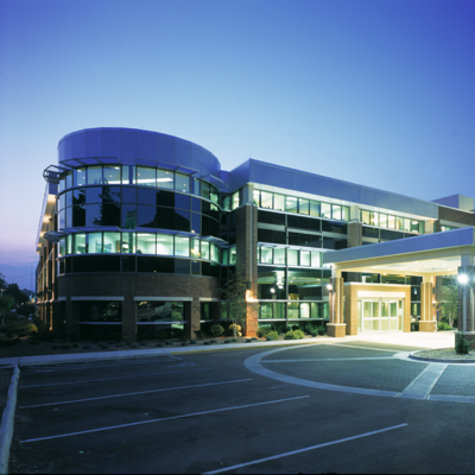
Carilion Clinic night view (SFCS photo).^

Radford University, working with Carilion Clinic and Jefferson College of Health Sciences in Roanoke will team to offer a doctorate degree in physical therapy next year.

The DPT program will be located in Carilion Roanoke Community Hospital, sharing space, services and resources with Jefferson College of Health Sciences.

Carilion Clinic Chief Operating Officer Nancy Agee says, "We have a long history with RU, working together in health professions education. We’re pleased to be able to jointly bring this new doctoral program to the Roanoke Valley. The three-year program will admit 25 students per year for a total of 75 students at full enrollment.

"It will not only help us meet an important patient need, [but] it sets the stage for future opportunities to collaborate. With these doctoral students joining our JCHS Nursing and Health students, Virginia Tech Carilion and University of Virginia medical students, Carilion Clinic Medical Education residents and fellows, we are building a remarkable center for health professions and medical education here in the Roanoke Valley."

Thursday, September 9, 2010

Broadband Slated for Alleghany Highlands

Congressman Rick Boucher explains how the plan will work.^

Waynesboro-based nTelos has announced its implementation plan for a $16 million federal broadband stimulus award to bring broadband services and infrastructure to underserved households, businesses, and community facilities in the Alleghany Highlands of Virginia.

The award, which required nTelos to match the $8 million federal grant, enables nTelos to build a "future proof" fiber optic network to serve the needs of Alleghany citizens for decades to come. In making the announcement, Congressman Rick Boucher said, “The new fiber-to-the-premise Internet access services will improve the quality of life in the region, providing residents and businesses in Alleghany County with new opportunities for communications, education, entertainment, shopping and conducting business online.

"Local entrepreneurs will be able to enhance their businesses with online tools and reach new customers, and residents will have the option of telecommuting. And the new high-speed Internet services will ensure the region is able to attract technology-based businesses.”

Chief Executive Officer Jim Hyde said, “nTelos has embarked on a century-long journey to achieve its status as a leader in the communications industry and in the regions we serve.”

nTelos received the federal stimulus award from the Rural Utilities Service 50/50 program under the American Recovery and Reinvestment Act of 2009. The service area is comprised of a majority of Alleghany County, minus the city of Covington and the towns of Clifton Forge and Iron Gate, which are already classified as "served" by the federal stimulus guidelines.

The service area will reach a population of almost 9,200 residents in an estimated 4,216 households.

Renovated 16 West Has First Ribbon-Cutting

Engineer and S&S Cafeteria co-owner John Garland addresses those assembled.^

This sign gives an indication of what the owners hope will be behind Door No. 1.^

The art deco interior of the building is all swirls and angles.^

Television cameraman shoots Garland delivering his introduction.^

This disk was replaced because it had so much water damage and is now a star feature.^

By DAN SMITH

John Garland took another step today toward reviving Design '79, the 30-year-old effort to re-define and renovate downtown Roanoke. Garland was at the old S&S Cafeteria building on Church Ave. to help cut the ribbon for the first tenant of the renovated building.

Oasis Chirpractic has been in the building since the early 1990s, but it has re-committed to the new design and hopes to be part of a growing trend in downtown living. Garland noted, in his brief remarks, that there are now more than 500 people living in downtown Roanoke and "people who live down here need and want amenities." His intention, he says, is to help provide them with the S&S, which he hopes will house restaurants, a food store and other services.

The building, which began as a Trailways bus station in the 1940s, has most recently been the home of a series of health clubs after being a cafeteria for many years. A good bit of the space in the large building will go for condominiums or apartments.

The renovation is one of three Garland and various partners has going in a two-block area. He is overhauling spaces at 108 Campbell and 209 First Street, primarily for living spaces. He has two condos under contract in the Campbell building and says another will sign as soon as his contract on the building is official. "We have had some serious lookers for the second floor at 108 and the third floor at 209," he says. "This has exceeded our expectations."

The slow pace of filling what is being called 16 West (the S&S building) has not exceeded his expectations and part of that, he says, is because the City of Roanoke offered vendors in the City Market Building, which is under renovation for the next nine months, $20,000 in money for equipment and other facilities if they return to the building when it re-opens. "I thought I might ask [Councilman Sherman] Lea if the city will chip in $20,000 for our vendors," Garland said, only half joking. He said he was "not sure it's a good thing" for the city to be competing with private enterprise.

Wednesday, September 8, 2010

CIO Daniel Barchi Leaving Carilion for Yale Medical

By DAN SMITH

Carilion Chief Information Daniel Barchi (right), a key player in the creation of Carilion Clinic’s updated, electronic medical record system and former president of the Carilion Biomedical Institute, is taking a job with the Yale School of Medicine and Yale New Haven System. Kay Hix will serve as interim CIO. She has been with Carilion 15 years and has been a manager with the Epic electronic records implementation team.

Chief Financial Officer Don Lorton says, “Although there are many benefits to the significant strides Carilion Clinic has made in recent years, one of the downsides of these accomplishments is that out talented people who worked to make it happen are sought after by others.”

Barchi, a former Naval officer, joined Carilion in 2003 as president of the Carilion Biomedical Institute. Says Lorton, “Through strong leadership and by guiding the partnership between Carilion, Virginia Tech, and the University of Virginia, Daniel and CBI were able to develop intellectual property into companies, guide millions of dollars of private equity and venture capital into our region, and create several hundred jobs.

“When he was appointed CIO in 2006, he aligned our Technology Services Group's operations and goals with those of the Clinic. He and his team recognized the value a single electronic medical record would have to our delivery of integrated, patient-focused care and for the past four years they have managed the most rapid and broadest scope Electronic Medical Records implementation in the U.S.

"A hallmark of Daniel's leadership is that he has helped his talented management team develop as system-wide leaders who understand how technology directly impacts the quality of care we deliver."

Tuesday, September 7, 2010

Tech's Bioinformatics Institute Seeks Link With Industry


The Virginia Bioinformatics Institute at Virginia Tech (above) has launched a new program aimed at bridging the gap between industry and university research. The institute’s Industrial Affiliates Program is designed to facilitate strong cooperative relationships and partnerships, as well as research and information exchange opportunities, with industry.

“Teaming with industry will help us target opportunities, tune our commercial translation process, and thereby move our research advances and inventions from the notebook or publication to valuable intellectual property, then ultimately into real products and services,” said Virginia Bioinformatics Institute Executive Director Harold “Skip” Garner. “Since joining the institute, one of my goals has been to obtain funding to support commercialization and entrepreneurial programs and the Industrial Affiliates Program is a key element of this process.”

With a vision to be a world leader in transdisciplinary life sciences and biomedical research and education, creating partnerships with industry will help the institute strengthen its commitment to making transformative discoveries, solving important problems, developing the next generation of transdisciplinary researchers, influencing public policy, and transitioning scientific research into use.

The financial assistance provided by industry partners will help advance the work at the Virginia Bioinformatics Institute that spans four program areas – network dynamics and simulation science and policy informatics, cyberinfrastructure, biosystems, and medical informatics and systems. The Industrial Affiliates Program offers companies two levels of sponsorship to support the institute’s research. The Gold Partner membership is available for companies seeking to better understand how research at the Virginia Bioinformatics Institute can impact their business.

For an annual gift of $25,000, Gold Partners receive access to non-proprietary information produced by the institute, opportunities to visit the institute’s facilities and participate in discussions with faculty members and students involving research activities, and access to events held at the institute’s 189-seat conference center and other meeting spaces. In addition, members at this level of sponsorship may submit research suggestions to the Research Advisory Panel, which recommends the research scope for the institute, and attend the annual meeting of the Virginia Bioinformatics Institute Futures Roundtable, a group created to discuss the strategic goals of the institute’s scientific program, as well as the implementation of these goals and related scientific and logistical issues.

For an annual contribution of $50,000, Platinum Partner membership is designed for companies seeking access to intellectual property generated by the institute’s faculty members. Partners at this membership level receive all of the benefits of the Gold Partner membership, as well as early licensing access to confidential research information prior to public disclosure and a seat on the Research Advisory Panel with the opportunity to provide input on the selection of annual research program projects.

In addition, Platinum Partners can earmark up to 80 percent of the their annual gift to support a graduate student fellowship to explore a research area relevant to the institute’s strategic plan.

A brochure on the program is here.

Thursday, September 2, 2010

Tech Faculty Making Hay With Stimulus Money

Virginia Tech faculty members have been awarded $28,689,393 from the American Recovery and Reinvestment Act (ARRA) in fiscal year 2010 (ending June 30, 2010) to support 76 research projects.

Awards since the act was passed in February 2009 total $34,561,554 for 91 projects. The funds help support students and staff working on the projects and have enabled purchase of major research instrumentation, said Robert Walters, vice president for research at Virginia Tech.

For example, the National Science Foundation (NSF) has awarded two major research instrumentation grants, one for $2 million to acquire a versatile heterogeneous supercomputer, and one for $ 661,240 to develop an instrument that measures the nanoscale forces involved in the motion of molecules in fluids, which will improve the understanding of motion of complex fluids, including biomolecules.

Of the 91 awards, 47 are from the NSF, including five Faculty Early Career Development awards, the NSF's most prestigious award in support of junior faculty who have demonstrated outstanding research, excellent education, and the integration of education and research. Two of the four U.S. Department of Energy grants are also Early Career Research Program awards. There are 15 National Institutes of Health research grants.

"Such awards are indicative of Virginia Tech’s growing prominence in health-related research, an area poised to become a growth sector within our institution’s research portfolio in the coming years," said Walters.

NIH awards include National Institute of Allergy and Infectious Diseases grants to identify targets for intervention of chronic human inflammatory diseases, to develop assays to detect infectious organisms, and to control mosquito-borne infectious diseases, such as malaria LaCrosse encephalitis.

The National Institute of General Medical Sciences has awarded two grants to study determinants of bacterial virulence and biofilm formation, and extended research by Stephen Eubank, Virginia Bioinformatics Institute professor, to study and model the emergence and spread of infectious diseases. The National Institute of Diabetes and Digestive and Kidney Diseases awarded $419,230 to Padma Rajagopalan, assistant professor of chemical engineering, to develop three-dimensional liver mimics comprised of cells found in livers, which will help research disease processes.

A $145,826 National Institute of Child Health and Human Development grant to Martha Ann Bell, associate professor of psychology, supports her research on Attention and Memory: Mother-Child Psychophysiology and Behavior. Other awards include, from the U.S. Department of Justice, a $354,794 cooperative agreement with Steve Ellingson, associate professor of electrical and computer engineering, to develop antenna systems for multiband mobile and portable radio; and from the National Institute of Standards and Technology, a $580,493 grant to Finley Charney, associate professor of civil and environmental engineering, and M.P. Shing, professor in engineering science and mechanics, for Development and Evaluation of Performance Based Earthquake Engineering Compliant Structural Systems.

There were 24 subawards to Virginia Tech from businesses, agencies, and institutions that received ARRA funding. For example, Community Housing Partners, a regional, not-for-profit housing and community development corporation, received stimulus funding from the U.S. Department of Labor Employment and Training Administration, and subsequently awarded $474,652 to Virginia Tech faculty members to be part of a collaboration to upgrade regional training capacities in western Virginia to offer energy conservation certification opportunities and update the skills of construction and retrofitting industry workers to help them compete in green building occupations.

(Photo: cardwellguardian.blogspot.com)

Wednesday, September 1, 2010

It's Back to Television for John Carlin

Former longtime WSLS-TV 10 news anchor John Carlin, who has had a busy year of job changes, has yet another new gig, this one back on television.

Carlin will join WFXR FOX 21/27 ‘s Ten O’Clock News team as host of “John Carlin’s Virginia,” seen every first and third Tuesdays of each month beginning Tuesday, Sept. 21.

Carlin left Channel 10 to join Access, a public realtions and advertising firm, but left that position after only a few months to join Ferrum College in PR. He also had a small PR firm of his own.

Carlin anchored the FOX 21/27 Ten O’Clock News for 13 years (in conjunction with his Channel 10 duties), from the day of its inception. “I look forward to getting back out there and meeting those people and sharing their view of the world,” he says. In “John Carlin’s Virginia,” he will travel the region and interview people.