William (Jamie) Tyler, who has received international attention for research on the development of low-intensity ultrasound for the treatment of such brain disorders as epilepsy and Parkinson's disease, has joined the Virginia Tech Carilion Research Institute in Roanoke.
Tyler will be an assistant professor with the institute and with the School of Biomedical Engineering and Science in the College of Engineering at Virginia Tech. He has been an assistant professor of neurobiology and bioimaging in the School of Life Sciences at Arizona State University since 2006.
In 2010, he was awarded the Arizona Governor's Innovator of the Year Award for Academia for his research on noninvasive brain stimulation therapies using ultrasound. His work has resulted in several patent applications, the development of prototype devices, and the formation of medical device company, SynSonix LLC, which is pursuing its R&D activities in Cambridge, Mass.
"My group studies the fundamental properties of synaptic transmission and how best to control neuronal activity for making nervous systems more efficient," he says. The ability to treat a number of major brain disorders that become unresponsive to pharmacological intervention, such as Parkinson’s disease, major depression, or severe seizures, can require invasive neurosurgery with the placement of stimulating electrodes deep into the brain. Such treatments are effective but risky, so they are used rarely and not until other treatment options have been exhausted. Tyler has demonstrated on laboratory animal models that pulsed ultrasound can be used to stimulate neuronal activity without the need for invasive brain surgery or genetic manipulation.
Tyler says, "The aim of his group’s work is to stimulate cells in specific regions of the brain to release communication molecules called neurotransmitters since many brain disorders are a result of disrupted communication between groups of nerve cells. Their work is supported by the U.S. Army Research, Development, and Engineering Command and the Defense Advanced Research Project Agency. SynSonix is developing a platform for medical devices that use ultrasound to regulate brain activity.
"We look forward to integrating several aspects of our research and development enterprise into the Roanoke and New River Valley technology corridors soon," Tyler says. In some embodiments, the SynSonix technology could take the form of helmet-mounted devices.
"While at this stage, the headgear is a bit bulky for around the clock wear, the military is interested because the technology is a promising way to treat soldiers returning from war who are suffering from traumatic brain injuries," Tyler says. Over 1.5 million Americans per year suffer a traumatic brain injury.
Not only are they the signature injury of the wars in Iraq and Afghanistan, but traumatic brain injuries are the greatest cause of death and disability in children as well as an increasingly important health issue for athletes and the aging population due to falls and poor balance.
Friday, February 11, 2011

Thursday, February 10, 2011
Roanoke Civic Center Gets New GM
 Global Spectrum, operator of the four-facility Roanoke Civic Center, has named Robyn Schon (pictured) general manager, replacing Chris Connolly, who has been promoted to GM of the Iowa Events Center in Des Moines. Connolly has served as GM of the Roanoke Civic Center since Global Spectrum was contracted to manage the facility in December, 2008.
Schon, who most recently was the Assistant GM of the Roanoke Civic Center, has worked in public assembly facility management for 25 years, the last 13 at the Roanoke Civic Center. She began her career in the marketing department and has served as the assistant GM for the last six years. She has a B.S. in organizational management from Bluefield College and earned her M.A. from Hollins University.
“Robyn was a tremendous asset to Global Spectrum when our company became managers of the facility,” says Global Spectrum COO John Page. “As we transitioned our company into Roanoke, Robyn showcased her talents and her knowledge of what it would take to operate a facility such as the Roanoke Civic Center. Working closely with Chris, she has obtained the additional skills to maintain a high-level of customer service and an eventful calendar to make the Roanoke Civic Center continue to flourish.
“We will certainly miss working with Chris on a daily basis,” says Schon. “He created a culture at the Roanoke Civic Center based on Global Spectrum's corporate philosophy, which is focused on offering exemplary customer service to our clients and guests, and bringing the best entertainment possible to this Valley. I hope to continue in the same direction and lead our organization to great success.”
“During the two years that Global Spectrum has managed the Roanoke Civic Facilities Complex, there has been a significant improvement in the quality of event programming and the financial condition of the facility,” said Sherman Stovall, assistant city manager for operations. “We expect and look forward to continued success in the relationship we have with Global Spectrum under Robyn Schon's leadership.”
Tuesday, February 8, 2011
Novozymes Deal Completed

Novozymes, a bio-innovation company with a plant in Roanoke County, has completed its acquisition EMD/Merck Crop BioScience. Novozymes moves into development of sustainable solutions for industry and agriculture.
“We’re excited to bring these two innovative companies together to help farmers produce more and better food, feed, fuel, and fiber while minimizing the environmental footprint,” says Thomas Videbæk, executive vice president of Novozymes.
The deal complements Novozymes’ existing agricultural biologicals business. Novozymes hopes to accelerate the development of new products for farmers.
“With the wider range of expertise and greater capacity for research and development, we’ll be able to introduce new products into the market quicker than before,” says Videbæk. “The acquisition expands our business reach, enabling us to deliver more value to more farmers globally.”
Following the acquisition, announced that expected revenue growth should increase from an expected 7-10 percent to 10-13 percent.
Wednesday, February 2, 2011
Carilion Community Benefit: $154.9 Million
 Carilion Clinic’s overall community benefit hit a new high in 2009, reaching $154.9 million. The expenditures were spread throughout the region, including the Roanoke and New River valleys and Giles, Tazewell, Franklin, Bedford and Rockbridge counties.
Carilion reports its community benefit to the Internal Revenue Service each year, basing the figures on IRS guidelines. Carilion Clinic is a community asset with no owners, investors or stockholders. Its revenue stays in the region and is reinvested to meet local health care needs.
As a not-for-profit organization, Carilion is exempt from paying most taxes (though Carilion does pay taxes on some property, including the new Riverside development in Roanoke). In 2009, Carilion was exempt from $22.7 million in taxes. In return, Carilion gave approximately $154.9 million back to the community, nearly $7 for every dollar of tax exemption.
Uncompensated care made up most of the reported community benefit, at $129 million. This includes charity care, Medicare and Medicaid costs that are not reimbursed, and the cost of care that is later classified as uncollectible. In 2009, Carilion provided an average of $350,000 in uncompensated care every day.
Carilion also provided $20.8 million to train doctors and other local health professionals, $2.7 million for community health improvement programs, $1.6 million in contributions and grants to community health organizations, and $680,430 to support local health research.
Tuesday, February 1, 2011
Walker to Buy 101.5 Radio Station
 Developer Ed Walker has his eye on 101.5.^
 Roanoke radio station WVMP, 101.5 FM, which has become something of a force in the Roanoke radio market during the past year with its listener-driven programming and expanding partnerships, is in the process of being purchased by developer Ed Walker, according to a news release.
The station, known as “The Music Place,” has caught the imagination of a broad range of Roanokers tired of bland music programming and ownership that doesn’t reflect anything about Roanoke.
Walker is the visionary downtown developer who has renovated several historic buildings and built the city's downtown community into a force.
Here’s the news release:
Roanoke CityWorks Community Broadcasting has filed for a change of ownership with the FCC, indicating its planned purchase of the assets of WVMP, 101.5 FM, pending FCC approval.
CCB is an initiative of CityWorks, the social entrepreneurship entity of community developer, Ed Walker, which uses principles from commerce, entrepreneurship, arts and culture, education and knowledge, as well as connectivity to strengthen community in the region. 101.5 has been owned by Centennial Broadcasting and operated by its local station manager, Tom Kennedy, and his staff.
In the 15 months since 101.5 the music place has been on the air, it has demonstrated its ability to garner a passionate and loyal following, comprised of a highly desirable listener profile, of an upscale, intelligent, discerning, difficult to reach audience. Through a format unique to this region, the Adult Album Alternative format is known for its singer/songwriter style, a large selection of music and artists, and a non-traditional approach to advertising.
The AAA format of 101.5 the music place, along with its involvement with local cultural arts and community stewardship, has helped spawn new economic and cultural development for the City. The community response has been of tremendous unity, a new enthusiasm for the Roanoke Valley, and of ancillary businesses emerging, through a growth in the cultural arts.
Under Centennial's ownership and Kennedy's leadership, 101.5 developed into an important and innovative contributor to the Roanoke Valley. Still, Centennial decided to head in different directions and began making preparations to sell 101.5. Over the last 14 months, Walker, of CityWorks, says he became familiar with 101.5 and admired the significant leadership role it was developing.
The station's focus on community initiatives and the curatorial quality of its programming, and deviation from traditional approaches to advertising were compelling to CityWorks and worth preserving, he says. Walker says the risk of losing 101.5 was significant enough to compel CityWorks to examine the possibility of buying the station, keeping the team in place, and to begin developing initiatives to vault 101.5 into the highest level of the nation's very finest, small AAA stations.
Walker says CityWorks intends to use its capital and creativity to continue the best aspects of 101.5 the music place, and to build on them to create a profitable enterprise and a powerful community resource. "Centennial's entire team has been so impressive and of such a high caliber. I'm grateful that they allowed Tom Kennedy develop his approach, which is of demonstrable benefit for Roanoke, and allowed us this time for a seamless transition," Walker says. “101.5 the music place will continue its work as a locally owned, true community station, in their promotion of local cultural arts and community stewardship.”
Following this transaction, Tom Kennedy will remain as meneral Manager, and will be employed by CityWorks Community Broadcasting.
Thursday, January 20, 2011
Tech, Wake To Collaborate on Animal Regenerative Medicine
The Virginia-Maryland Regional College of Veterinary Medicine has entered into a research agreement with the Wake Forest Institute for Regenerative Medicine at Wake Forest University Baptist Medical Center in Winston-Salem, N.C. They signed a memorandum of understanding to form the Virginia Tech/Wake Forest Center for Veterinary Regenerative Medicine (CVRM).
The veterinary college and the institute for regenerative medicine, both leaders in their fields, will engage in ongoing collaborations in translational research in regenerative medicine through the new center. The agreement facilitates the application of cutting-edge regenerative treatments to both human and animal patients.
“Translational research” focuses on turning the biological discoveries of scientists and clinical researchers into innovative treatments for the benefit of patients. “Regenerative medicine” specifically refers to the creation of tissues and organs in the laboratory that can be used to repair or replace damaged tissues in living patients and the use of cell therapies to restore the function or organs and tissues. As part of the collaboration, clients at the Veterinary Teaching Hospital may have the option to enter their pets into clinical trials, giving them access to cutting edge technology unavailable elsewhere.
The agreement will enable the Wake Forest Institute for Regenerative Medicine to evaluate new regenerative medicine techniques in spontaneously occurring animal diseases that can be models for human disease. This collaboration with the veterinary college will allow researchers at Wake Forest to more quickly assess the efficacy of regenerative treatments to remedy clinical conditions and facilitate their application to human medicine.
Researchers at the veterinary college believe the agreement represents a win-win for both animals and humans. “The CVRM is a tremendous opportunity to provide new medical alternatives for animals, including loved household pets, while generating scientific knowledge that can save and transform human lives,” says Roger Avery, senior associate dean of research and graduate studies at the Virginia-Maryland Regional College of Veterinary Medicine.
Current research focuses on chronic kidney disease in cats, which are being treated in an effort to induce kidney regeneration and restore renal function. Additionally, a stem cell approach is being applied to dogs with spay-induced induced incontinence, a reoccurring problem in spayed female dogs.
Muscle stem cells, placed into the neck of the dog’s bladder, may help to strengthen the bladder muscle and cure the condition. Other collaborative projects including canine and bovine induced pluripotentent cells, rapid pathogen detection, wound healing in horses, and canine cardiomyopathy are in start-up mode.
Willard H. Eyestone, research assistant professor of reproductive biology and biotechnology at the Virginia-Maryland Regional College of Veterinary Medicine, will act as lead faculty member at the veterinary college and the liaison to Wake Forest in the collaboration. Dr. J. Koudy Williams, professor of pathology and surgical sciences at Wake Forest, will serve as the lead faculty member from the institute.
The veterinary college and the institute for regenerative medicine, both leaders in their fields, will engage in ongoing collaborations in translational research in regenerative medicine through the new center. The agreement facilitates the application of cutting-edge regenerative treatments to both human and animal patients.
“Translational research” focuses on turning the biological discoveries of scientists and clinical researchers into innovative treatments for the benefit of patients. “Regenerative medicine” specifically refers to the creation of tissues and organs in the laboratory that can be used to repair or replace damaged tissues in living patients and the use of cell therapies to restore the function or organs and tissues. As part of the collaboration, clients at the Veterinary Teaching Hospital may have the option to enter their pets into clinical trials, giving them access to cutting edge technology unavailable elsewhere.
The agreement will enable the Wake Forest Institute for Regenerative Medicine to evaluate new regenerative medicine techniques in spontaneously occurring animal diseases that can be models for human disease. This collaboration with the veterinary college will allow researchers at Wake Forest to more quickly assess the efficacy of regenerative treatments to remedy clinical conditions and facilitate their application to human medicine.
Researchers at the veterinary college believe the agreement represents a win-win for both animals and humans. “The CVRM is a tremendous opportunity to provide new medical alternatives for animals, including loved household pets, while generating scientific knowledge that can save and transform human lives,” says Roger Avery, senior associate dean of research and graduate studies at the Virginia-Maryland Regional College of Veterinary Medicine.
Current research focuses on chronic kidney disease in cats, which are being treated in an effort to induce kidney regeneration and restore renal function. Additionally, a stem cell approach is being applied to dogs with spay-induced induced incontinence, a reoccurring problem in spayed female dogs.
Muscle stem cells, placed into the neck of the dog’s bladder, may help to strengthen the bladder muscle and cure the condition. Other collaborative projects including canine and bovine induced pluripotentent cells, rapid pathogen detection, wound healing in horses, and canine cardiomyopathy are in start-up mode.
Willard H. Eyestone, research assistant professor of reproductive biology and biotechnology at the Virginia-Maryland Regional College of Veterinary Medicine, will act as lead faculty member at the veterinary college and the liaison to Wake Forest in the collaboration. Dr. J. Koudy Williams, professor of pathology and surgical sciences at Wake Forest, will serve as the lead faculty member from the institute.
Tuesday, January 18, 2011
Tech's Center for the Arts Interior Design Released
 Details for the interior of the new $89 million Center for the Arts at Virginia Tech are beginning to emerge with drawings available here. Simply click on any of the images and it will enlarge.
According to a Tech press release, the devil is in the details:
The selection of the fixed seating in the performance hall, for example, included the examination of not only comfort, but also acoustic qualities, repeated-use wear and silence of their moving parts. Earlier in the design process, it was determined that the depth of the first balcony negatively affected acoustics and recommended that 40 seats be removed from the original 1,300 planned for the space. The maximum number of seats, and therefore tickets that could be sold, was reduced to 1,260 without hesitation.
Arup, a global engineering and acoustics firm with corporate offices in New York City, is leading the team on matters of acoustics. Arup has worked with major institutions from the Sydney Opera House to the Louvre and the Guggenheim. The material, called "skin," covering the ceilings and walls of the performance theater has been tested and specifically selected for its acoustic qualities. Everything in the performance theater, from the shape of the theatre boxes and balconies to the positioning of lights, has been chosen for its acoustic qualities.
The visual arts exhibition galleries has put emphasis on versatility. The galleries are being designed and constructed to support not only traditional two-dimensional and three-dimensional art, but also virtual, digital, live, and performance art. Moveable walls, a variety of lighting options, room darkening capabilities, and more will make these galleries an adaptive space for visual arts.
Laboratories and studios are also under development for the center's Institute for Creativity, Arts and Technology. A 3,000-square-foot creative performance lab is part of the center's spaces for the activities of the institute.
Spaces dedicated to the institute will be housed in the part of the center that is Shultz Hall. The Virginia Tech Corps of Cadets, which has for years taken most of its meals in the un-air conditioned Shultz Hall, will eat in a new, state-of-the-art dining center on Turner Street. The new dining center will be open to all and will also provide some space for academic programs of the university.
"With input and guidance from a steering committee, a building committee and numerous groups with technical expertise, which are composed of deans, department heads, faculty, administrators, and graduate students from across campus, I believe we are making sound choices for the Center for the Arts," says Director Ruth Waalkes, "Choices that will translate into a unique world-class center, where performance arts, visual arts, and technology intersect."
The $89 million Center for the Arts will open in fall 2013, but has already begun co-presenting programs. The next Center for the Arts co-sponsored event is the nine-time Grammy Award-winning Emerson String Quartet with the Department of Music on Jan. 28 at the Lyric. Then, on Feb. 12, the center presents the Roanoke Symphony Orchestra virtuosi group with the New River Valley Friends of the Roanoke Symphony at the Squires Recital Salon. In June and July, the center will present the Vocal Arts and Music Festival (formerly Viva Virginia).
Monday, January 10, 2011
Goodman, Dixon Hughes To Merge
 Goodman & Company, which has a significant presence in Roanoke, and Dixon Hughes plan to merge their firms and affiliated entities March 1.
Headquartered in Charlotte, the combined firm will be known as Dixon Hughes Goodman LLP. With more than 1,700 people in 30 offices in 11 states and D.C., Dixon Hughes Goodman will be the largest certified public accounting firm based in the Southern U.S. and the 13th largest in the nation.
Goodman & Company will retain all of its existing Virginia, Maryland and Washington, D.C. offices, and will seek to expand its presence within this footprint as part of the merger. Thomas H. Wilson, Managing Partner of Goodman & Company, will become Deputy Chairman and Chief Operating Officer of the new firm. Charles Edgar Sams Jr., chairman of Dixon Hughes, will continue to serve as chairman of the new company, and Kenneth M. Hughes, CEO of Dixon Hughes, will also remain in that position.
“This is a tailor-made fit that will benefit the firm, our staff and most importantly, our clients,” says Wilson. “Both organizations will gain increased industry expertise and depth and see new geographic opportunities for growth. Clients will have broadened access to capital networks and industry best practices, while our employees will see more robust training options, increased opportunities for industry specialization and greater mobility between offices.”
“Both firms have a strong affinity for providing exceptional service and in-depth industry knowledge on behalf of our clients,” said Sams. “This combination will create a larger platform in which we can expand our geographical reach throughout the mid-Atlantic, share core technical resources and anticipate the needs of our clients. We are enthusiastic as we move forward over the coming months.”
The merger will create a dramatically larger geographic footprint with offices located in Alabama, Florida, Georgia, Maryland, North Carolina, Ohio, South Carolina, Tennessee, Texas, Virginia, D.C. and West Virginia. The firm will conduct business in all 50 states.
Thursday, January 6, 2011
Cantal To Locate in Botetourt, Bring 40 Jobs
 Canatal Steel USA Inc., which develops steel structures for commercial buildings, has opened its first U.S. operation in Botetourt County. U.S. customers comprise about 95 percent of the Canadian company's business.
“With so much of our business in the United States, we were looking to increase efficiency, reduce costs and streamline our operations,” says Charles Trent, controller of Canatal Steel USA. “Botetourt County puts us closer to our customers and offers affordable operating costs and an experienced, motivated work force.”
Canatal Industries fabricates and installs steel beams primarily for commercial, residential, institutional, and industrial building construction. Located in the former O’Neal Metals Building, the company will initially invest more than $1 million in facility and equipment. Canatal plans to create up to 40 full-time jobs by April 2011 and could create as many as 100 by 2012. Jobs will range from welders and fitters to eventually office staff, estimators and engineers.
The company says it’s seeing an uptick in orders as the economy improves. “We have aggressive growth plans in Botetourt and look forward to being an integral part of the Roanoke Valley,” Trent says. Canatal considered locations outside of the Commonwealth of Virginia before selecting Botetourt County.
“Canatal’s decision to locate in Botetourt adds to the international roster of businesses in the county,” says Billy Martin, chairman of the Botetourt County Board of Supervisors. “Now, Canada joins Australia, Austria, Belgium, Japan, Mexico, and Greece doing business from Botetourt.”
“The international flavor of businesses throughout the Roanoke region reflects the region’s global competitiveness,” saysBeth Doughty, executive director of the Roanoke Regional Partnership.
Wednesday, January 5, 2011
Montgomery Chamber Selects VCOM Best

The Edward Via College of Osteopathic Medicine – Virginia Campus was the recipient of the area’s “Business of the Year” award by the Montgomery Chamber of Commerce at the December Annual Chamber Dinner. VCOM was one of nine organizations nominated for this award which recognizes community involvement; civic and charitable contributions; innovation: and economic impact to the Montgomery County, Virginia community.
Since its founding in 2002, VCOM, a not-for-profit business, has graduated over 600 physicians and employed hundreds of faculty and staff members. Currently enrollment is over 720 doctoral and 30 post-baccalaureate students. VCOM has grown from one to four buildings, including a research building and a simulation and technology building with state-of-the-art equipment for educational instruction and evaluation.
While much of the country is facing a physician workforce shortage, the addition of VCOM has guaranteed a medical student population that, along with the additional four medical schools should meet Virginias needs. The economic impact of the medical school to the local economy is noteworthy.
The total economic impact of VCOM’s operations is at over $210 million annually with direct expenditures in excess of $38 million. As a private, accredited college, VCOM has never required state funds for operations or construction, resulting in no cost to the taxpayer. In addition to academically preparing strong physician graduates, VCOM also contributes to the community by providing a summer enrichment program for high school students; health education to middle and high school students and other community groups ranging from free clinic patients to AARP members; by fundraising for those in need; and providing patient care as part of the clinical education program.
According to Dr. Jim Wolfe, VCOM’s president, “We were thrilled to hear we were selected by the Montgomery Chamber of Commerce for this Award, particularly knowing that there were many other quality organizations in this category. We are pleased to have had a positive impact on the region and we look forward to continued growth and additional contributions to the community”
Whole Antibiotics Entering Our Water, Tech Finds

Virginia Tech Researcher Amy Pruden was part of the team that studies antibiotics in our water.
When an antibiotic is consumed, researchers have learned that up to 90 percent passes through a body without metabolizing. This means the drugs can leave the body almost intact through normal bodily functions.
In the case of agricultural areas, excreted antibiotics can then enter stream and river environments through a variety of ways, including discharges from animal feeding operations, fish hatcheries, and nonpoint sources such as the flow from fields where manure or biosolids have been applied.
Water filtered through wastewater treatment plants may also contain used antibiotics. Consequently, these discharges become “potential sources of antibiotic resistance genes,” says Amy Pruden, a National Science Foundation (NSF) Faculty Early Career Development (CAREER) award recipient, and an assistant professor of civil and environmental engineering at Virginia Tech. “The presence of antibiotics, even at sub-inhibitory concentrations, can stimulate bacterial metabolism and thus contribute to the selection and maintenance of antibiotic resistance genes,” Pruden explains. “Once they are present in rivers, antibiotic resistance genes are capable of being transferred among bacteria, including pathogens, through horizontal gene transfer.”
The World Health Organization and the Center for Disease Control recognize antibiotic resistance “as a critical health challenge of our time,” Pruden writes in a paper published in a 2010 issue of Environmental Science and Technology. Pruden says reducing the spread of antibiotic resistance is a critical measure needed to prolong the effectiveness of currently available antibiotics.
This is important since “new drug discovery can no longer keep pace with emerging antibiotic-resistant infections,” Pruden says. Pruden who has developed the concept of antibiotic resistance genes as environmental pollutants has an international reputation in applied microbial ecology, environmental remediation, and environmental reservoirs of antimicrobial resistance. In her work outlined in the "Environmental Science and Technology" article, she and her co-authors identified specific patterns of antibiotic resistance gene occurrence in a Colorado watershed.
Identification of these patterns represents a major step in being able to discriminate between agricultural and wastewater treatment plant sources of these genes in river environments. They assert that such unique patterns of antibiotic resistance gene occurrence represent promising molecular signatures that may then be used as tracers of specific manmade sources. In their study they identified three wastewater treatment plant sites, six animal feeding operation locations, and three additional locations along a pristine region of the Poudre River, in an upstream section located in the Rocky Mountains.
They compared the frequency of detection of 11 sulfonamide and tetracycline antibiotic resistance genes. Their findings showed detection of one particular antibiotic resistance gene in 100 percent of the treatment plant and animal feeding operations, but only once in the clean section of the Poudre River.
As they are able to differentiate between human and animal sources of the antibiotic resistance genes, Pruden and her colleagues believe they can “shed light on areas where intervention can be most effective in helping to reduce the spread of these contaminants through environmental matrixes such as soils, groundwater, surface water, and sediments.
“This study advances the recognition of antibiotic resistance genes as sources to impacted environments, taking an important step in the identification of the dominant processes of the spreading and transport of antibiotic resistance genes.” The Colorado Water Resources Research Institute and a U.S. Department of Agriculture's Agricultural Experiment Station provided funding for this study in addition to Pruden’s NSF award.
Free Money for Manufacturers: Apply by Feb. 8
Southwest Virginia companies in the transportation equipment-manufacturing sector may be eligible for grant money--but Virginia Tech needs to hear from those companies by Feb. 8. The money is coming to Southwest Virginia under a $1.67 million project from the U.S. Department of Commerce.
Companies involved in transportation equipment manufacturing and their suppliers may be available for grants totaling about $1 million. Projects will focus on product development, process improvement, and green technologies. Virginia Tech faculty members, most from the College of Engineering, provide technical assistance.
About 20 projects will be funded in the 14-county corridor from Bristol and beyond Roanoke, extending almost to Natural Bridge. For more information about the initiative and eligibility requirements, call Robert Taylor, director, Center for High Performance Manufacturing at Virginia Tech, (540) 231-6201, or e-mail the center here.
“What companies should consider applying for the grants?” asks John Provo, interim director of the Virginia Tech Office of Economic Development. “Companies that could benefit from the application of Virginia Tech’s research and technical expertise to problems or opportunities in their businesses. In many instances, these projects will require human assets or equipment not readily available to the company.” Job creation is the goal of the project, aimed to bolster an industry that still employs 8,000 workers in Southwest Virginia. The project, called the Western Virginia Transportation Equipment Manufacturing Competitiveness Initiative, involves partners such as the New River Valley Planning District Commission, the Mount Rogers Planning District Commission, and the Roanoke Valley-Alleghany Regional Commission. Also involved is Volvo Trucks North America, New River Valley Plant.
A series of informational meetings are scheduled starting Monday so companies can learn more about the initiative and how to get involved:
Companies involved in transportation equipment manufacturing and their suppliers may be available for grants totaling about $1 million. Projects will focus on product development, process improvement, and green technologies. Virginia Tech faculty members, most from the College of Engineering, provide technical assistance.
About 20 projects will be funded in the 14-county corridor from Bristol and beyond Roanoke, extending almost to Natural Bridge. For more information about the initiative and eligibility requirements, call Robert Taylor, director, Center for High Performance Manufacturing at Virginia Tech, (540) 231-6201, or e-mail the center here.
“What companies should consider applying for the grants?” asks John Provo, interim director of the Virginia Tech Office of Economic Development. “Companies that could benefit from the application of Virginia Tech’s research and technical expertise to problems or opportunities in their businesses. In many instances, these projects will require human assets or equipment not readily available to the company.” Job creation is the goal of the project, aimed to bolster an industry that still employs 8,000 workers in Southwest Virginia. The project, called the Western Virginia Transportation Equipment Manufacturing Competitiveness Initiative, involves partners such as the New River Valley Planning District Commission, the Mount Rogers Planning District Commission, and the Roanoke Valley-Alleghany Regional Commission. Also involved is Volvo Trucks North America, New River Valley Plant.
A series of informational meetings are scheduled starting Monday so companies can learn more about the initiative and how to get involved:
- On Jan. 11 from 10 to 11 a.m. at the New River Valley Planning District Commission located at 6580 Valley Center Drive in Radford;
- Jan. 12 from 3 to 4 p.m. at the Mount Rogers Planning District Commission located at 1021 Terrace Drive in Marion; and
- Jan. 13 from 10 to 11 a.m. at the Roanoke Valley Alleghany Regional Commission at 313 Luck Ave. in Roanoke.
Tuesday, December 21, 2010
Businessman Gordon Willis Sr. Dies in Roanoke
Roanoke businessman Gordon Willis Sr., a who played a role in some of the most significant issues of his time, died in late December at 90 after a long illness. Professionally, he worked in his family’s business, Rockydale Quarries Corp., and he was an organizer of North Cross School and the Virginia Community College system, also serving as chairman of the State Council of Higher Education for Virginia.
He worked in the 1960s on Roanoke’s biracial committee, which helped ease the tensions that led other communities into explosive confrontations. He was honored with, among other things, Noel C. Taylor Humanitarian Award from Total Action Against Poverty and a Brotherhood Award from the National Conference of Christians and Jews. In 1992 by Gov. Douglas Wilder named him a Cultural Laureate of Virginia. Virginia Tech’s experimental Smart Road was named after Willis because of his advocacy. He served on the board of Roanoke Electric Steel Corp. (Steel Dynamics Roanoke Bar Division).
Thursday, December 16, 2010
Team Effort: Digital version of ER Pediatric Response Chart

At a practice emergency room facility, Dr. Andre A. Muelenaer Jr. (left) and Virginia Tech College of Engineering graduate student Carlos Guevara display the large-screen digital format of the Broselow Tape, developed in conjunction with the college, Carilion Clinic Children’s Hospital and the tape’s original creator, James Broselow.
A well-known paper-based medical chart used by pediatric emergency personnel across America is undergoing a 21st century boost in an collaborative effort between Virginia Tech’s College of Engineering, Roanoke-based Carilion Clinic Children’s Hospital and the physician who created the original method some 25 years ago.
The Broselow Pediatric Emergency Tape – otherwise known as the Broselow Tape -- has been a staple of emergency rooms and child trauma units for nearly three decades. Created by Hickory, N.C.-based physician James Broselow, the Broselow Tape is a long, durable tape measure used on child during a medical emergency.
Using a color-coded format, it provides a specific medical instructions – amounts of medicines to dispense or level of shock voltage to emit from a defibrillator, for instance – to medical caregivers based on the height and then subsequent weight of the child. This information now will be displayed on a large LCD monitor within emergency rooms, for all personnel to see.
“We are converting the existing Broselow Tape into an electronic format to improve resuscitation team communications and patient safety,” said Dr. Andre A. Muelenaer Jr., an associate professor of pediatrics at the Virginia Tech Carilion School of Medicine and director of the Pediatric Medical Device Institute, located in Roanoke.
Additional displayed information will include medicines administered to the patient, including the time of administration and the next scheduled allotment. In the instance of burns, an automated calculation of the affected surface area will be displayed, along with automated calculation of fluid resuscitation.
A click of a mouse/remote control can move responders from one screen to another. The software running the newly-dubbed eBroselow software program runs on LabVIEW, owned by National Instruments. Known as TEAM Broselow, the method is being tested at various hospitals, including facilities in Roanoke; Austin, Texas; and Winston-Salem, N.C., and will be fine tuned as additional input comes in from doctors, nurses, and other medical personnel, said Muelenaer.
Many of the new features already include input from medical personnel around the country, Muelenaer said.
Sunday, December 12, 2010
Seeking Customer Service Stories

Valley Business FRONT's cover story for March will be an examination of customer service in our Roanoke Valley-New River Valley regions and we'd like your help in livening up the story with some good examples of customer service: the good, the bad and even the ugly.
We do not want anonymous stories. We are asking for stories that are true and telling of the kinds of customer service one can expect in this region. We will likely contact any companies named for their side of it if negative, but if you don't name the company--simply give the area it works in, say "a bank in Roanoke"--we will go with your story.
We would like to take photos of those participating, as well.
Let us hear your stories and tell them to the business community. That community can learn from them.
E-mail Dan Smith at editrdan@msn.com or call 540-556-8510.
(Photo: onlineinvestigai.com)
Wednesday, December 8, 2010
Honoring Valley Business FRONT's Contributors
 Emily Field accepts her Most Valuable Staffer award from Editor Dan Smith.^
 David Perry (right rear) apparently wishes he could be one of the girls: Jill Elswick (from left), Jane Dalier, Susan Ayers, Anne Piedmont and Donna Dilley.^
 Susan Ayers gets one of her two awards from Publisher Tom Field (left) and Editor Dan Smith.^
 Paulette Jayabalan (center) shakes hands with Susan Ayers, as Donna Dilley watches.^
 Keith Ferrell and Kathy Surace commiserate.^
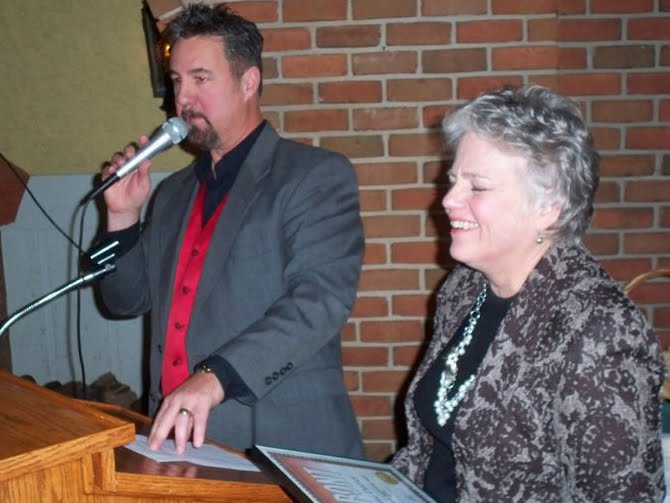 Tom Field cracks a joke at marketing award winner Jane Dalier's expense.^
 Writers Mike Miller (left) and David Perry pose. Below speaker Nancy Agee of Carilion with her pal Dan Smith and award winner Rob Johnson.^
Valley Business FRONT's annual writers awards luncheon was a source of celebration for nearly 30 people who contribute to the region's best business publication. Guest speaker Nancy Agee of Carilion, who was FRONT's first subscriber and who is a member of its editorial board and a voracious reader, praised the quality of the writing in the magazine.
A list of award winners is in the following post. Alison Weaver became the first person to win both the Contributor of the Year and Story of the Year awards.


Company Bringing 80 Jobs to Franklin
 Solution Matrix, Inc., a leader in cold-therapy products for the health care industry, will relocate its headquarters and manufacturing operations from Pennsylvania to Franklin County. The company expects to be in operation by November 2011.
The company will invest $2.25 million in building and equipment, constructing a 25,000-square-foot facility on a 4.27 acre site in the Franklin County Commerce Center along US Highway 220 south of Rocky Mount. Employment is projected to be 80 within three years.
Positions will range from production workers to managers and the average annual wage for all jobs will be between $20,800 and $37,440.
“The business climate and market access inherent in a Franklin County, Virginia, location will help our company manage its growing market share,” says Keith Marshall, president of Solution Matrix. “Franklin County also offers an experienced and motivated work force.”
Privately held Solution Matrix designs, manufactures and sells cold-therapy products used by hospitals, physical therapists and other health care providers post-surgery for joint replacement or rehabilitation from acute sports and other orthopedic injuries.
“Solution Matrix is a growing business and market leader," says Charles Wagner, chairman of the Franklin County Board of Supervisors. "It is the kind of state-of-the-art company we seek to attract to Franklin County and our community is pleased to welcome another health science company to the Commerce Center."
“We are delighted to welcome a medical equipment manufacturer to the region," says Beth Doughty, executive director of the Roanoke Regional Partnership. "It strengthens this growing cluster."
The company will receive a $150,000 grant from the Virginia Tobacco Commission, $50,000 performance grant from Franklin County, and training funds from the Virginia Department of Business Assistance. For information on the company visit here.
Alison Weaver Top FRONT Contributor

 Double winner Alison Weaver flanked by Publisher Tom Field (left) and Editor Dan Smith. Right is Susan Ayers. Below are Janeson Keeley and David Perry.^
 Alison Weaver became the first double winner in the annual Valley Business FRONT Writers Awards Tuesday at the Hunting Hills Country Club. Alison's distinction does not just cover the two-year history of the FRONT, either. It goes back to the Blue Ridge Business Journal, where the awards began more than 15 years ago.
She was named both the Contributor of the Year and finished first in an extremely strong field for Story of the Year for her piece "Frat Boys of ITT," the story of a group of fired fiber optics division professionals who went on to great success in other careers. Several of her cover stories were in the final mix of the competition, but runners up were Susan Ayers ("Real Estate") and Rob Johnson ("Betrayed").
Alison was an assistant editor with the Blue Ridge Business Journal about 15 years ago and later became a copy editor at the local daily paper. She has worked with FRONT virtually from the start.
Susan was selected as the Editor's Choice award winner by Editor Dan Smith who chooses his own criteria each year. This year, he said, "the award goes from Susan's terrific grit. She is a bulldog who won't let go of a story until it's right--in much the same vein as Alison. But she's a newbie, working at this level for less than a year. She has been truly impressive."
David Perry, last year's Contributor of the Year, took the Photograph of the year, a shot of a local banker riding a bicycle that was filled with motion. Janeson Keeley, another rookie who has written 12 columns for FRONT on the Internet, was the Columnist of the Year. Said Smith, "Janeson works this beat like nobody else. She only gets about 500 words an issue, but often interviews as many as six people for a column."
Office Manager and bookkeeper Emily Field was named the Staffer of the Year for her overall contributions to the business--which are enormous--and Jane Dalier, an advertising executive who has taken over social media marketing--won the Marketing Guru Award, as selected by Publisher Tom Field.
Wednesday, December 1, 2010
Spilman Firm Adds Bank Group
 The Regional law firm Spilman Thomas & Battle has formed the Community Banking Group to serve the needs of community banks. “We are excited to offer legal services tailored to community banks,” says Eric W. Iskra of client relations. “We have closely followed the growth trend of smaller banks and financial services providers for several years, and we see this sector as a real driving force in the economy of the Mid-Atlantic Inland Basin.”
This new Spilman practice group consists of an insightful and experienced team of more than 20 attorneys from a cross-section of Spilman’s current practice groups. In comprehensive fashion, its attorneys will advise clients across a broad range of areas of law including: mergers and acquisitions, tax, wealth management, labor and employment, regulatory, securities, white collar/compliance, construction, corporate, and bankruptcy and creditors’ rights – in addition to traditional banking and finance matters.
Timothy R. Moore, Counsel in Spilman’s Winston-Salem office, will lead the new practice group. He has a depth of experience working with community banks, as well as extensive knowledge in traditional banking and finance law. Moore says
, “These firms, which are regulated differently than larger FDIC-type financial institutions, have different needs when it comes to legal advice and representation. We responded by aligning our services and organizing our personnel to directly serve community banks and savings banks around their specific needs. Our goal is to act as an extension of our community banking clients rather than an outside service.”
College to Rent Patrick Henry Rooms for Students
 Patrick Henry Hotel in downtown Roanoke.^
Roanoke's Jefferson College of Health Sciences (JCHS) will house its fall 2011 resident students in the Patrick Henry Hotel building that is currently undergoing a total renovation at 617 South Jefferson Street. Developer Ed Walker is creating a multi-use facility at the old hotel, most of its rooms being residental.
The move of resident students to the Patrick Henry will allow JCHS to almost double its number of resident students. Seventy-seven JCHS students live on the eighth floor of Carilion Roanoke Community Hospital. The move also provides housing for JCHS students within walking distance of the college’s campus at Community.
In summer 2010, all JCHS services and resources were relocated to CRCH from the Reid Center at 920 South Jefferson Street. The agreement comes as JCHS continues to see record numbers of applications from prospective students, which also increases the demand for housing.
JCHS will occupy multiple floors in the new residence space at the Patrick Henry building, each of which will include one-bedroom, two-bedroom and studio apartment style units.
Subscribe to:
Posts (Atom)