Thursday, October 28, 2010

Prime Photonics Finds Partner

Lios Technology, which distributes OFDR distributed temperature measurement systems; has announced a partnership agreement with Blacksburg’s Prime Photonics, which concentrates on environment sensor solutions for the commercial and military product marketplace.

The benefit of this cooperation between suppliers of fiber optic based measurement systems and sensors, say executives, is to combine customer bases and expand the scope of measurements offering point-type as well as distributed measurements. Says Konrad Linckh, vice president of Lios Technology.

"This partnership allows Lios Technology to expand its market penetration, combine the application knowledge with Prime Photonics and offer an increased range of measurement options.”

“We see tremendous potential for LIOS distributed sensing products in the US and we look forward to exploring the significant product and technology synergies that will be available through the partnership of LIOS and Prime,” says Steve Poland, Prime Photonics CEO

A Realtor-Farmer With the Giving Gene

Darin Greear with his load today.^

Darin Greear, a Realtor with The Palmer Team at Long & Foster and the owner of a farm in Riner is shown with a truck load of home grown veggies destined to become a donation.

This load of 6,800 pounds of turnips and 2,300 pounds of winter squash were delivered to the Radford Worship Center today. The load is just a small fraction of food donations he will make by the year’s end. So far this year he has delivered 30,000 pounds of veggies.

Last year his donations exceeded 60,000 pounds and were sent to over 20 food pantries and shelters. Darin works with Sarah Ramey of Virginia Gleaning Network & the Society of St. Andrew to get his produce in the hands of people who are in need of it.

Company Puts R&D Arm in Roanoke

Maxx Performance today announced it will open a research & development and manufacturing facility in Roanoke, creating a projected 12-15 jobs over the next three years and investing up to $700,000 in equipment.

The company will be located in the former Valley Rich Dairy building on Aerial Way Drive. Maxx Performance is a provider of microencapsulation/encapsulation technologies used by manufacturers of baked products, confection goods, dairy or meat products, nutritional supplements, and animal feed.

The company’s products mask taste and off-odors, extend shelf life, and enhance flavor and texture to help manufacturers overcome application and processing challenges, optimize product delivery, and improve time to market.

“Our new Virginia-based facility will house a state-of-the-art application test center where customers can evaluate our ingredients in their products and develop formulations that can be scaled up,” says Dr. Winston Samuels, president and CEO. “It will also allow us to work with the brightest minds at Virginia Tech to innovate more of the practical applications our customers need to succeed.

"Locating our facility in Roanoke enables us to give back to the region some of what was given to us while we were students at Virginia Tech.”

Microencapsulation is at the leading edge in food formulation technology. For example, bitter tastes such as caffeine, green tea extract or certain vitamins and minerals can provide healthful benefits but affect how foods taste.

Microencapsulation, containing these ingredients and their tastes in microscopic capsules, enables the tastes to be managed within a completed product and, for example, reduce the need for artificial sweeteners. “As the economy emerges from the recession, we are seeing more interest in the Roanoke region as a business location,” says Beth Doughty, executive director of the Roanoke Regional Partnership.

Headquartered in Chester, N.Y., the company (here) is a privately held firm established in 2004. The company is locating within Roanoke’s Enterprise Zone and will be eligible to receive associated state and local incentives.

Wednesday, October 27, 2010

Yokohama To Spend $13 Million on Salem Expansion

The Yokohama Tire plant in Salem will expand considerably.^

Yokohama Tire Corporation (YTC) announced today that it is expanding operations at its Salem manufacturing plant because of increasing demand for its consumer and light truck tires.

The $13 million project will include new tire-making machinery, upgrading and modifying existing machines and an increase in high-performance and light truck tire manufacturing flexibility. The expansion is to be completed by August 2011.

“We have seen strong demand and our increase is well above the industry average,” says Dan King, Yokohama vice president, sales and marketing. “We have gained more allocation from our offshore plants, but it is not enough. That’s why the expansion at Salem will help fill the pipeline with our popular consumer tires, as well as light truck tires.”

King says the strong demand for Yokohama tires is across the board. In June, for instance, YTC’s parent company in Japan announced a third-term expansion in its Thailand plant. The investment will cost 9.7 billion yen ($117 million) and will increase the plant’s capacity to produce passenger car and light truck tires by 1.4 million units. This will expand the plant’s overall output to four million tires annually.

The Thailand plant has been producing passenger car and light truck tires since 2006, and tires for trucks and buses since April 2005.

“The plant expansions are a strategic initiative aimed at ensuring that our product supply is in step with the market demand,” says King. “The investments are a reinforcement of Yokohama’s commitment to the consumers and our dealer network.”

LewisGale drops the hyphen

Victor Giovanetti makes the announcement of the name change.^

HCA Virginia Health System announced its new branding strategy for LewisGale Regional Health System today at a press conference.

Joined by the CEOs of regional HCA hospitals, Greg Madsen (Alleghany), Scott Hill (Montgomery) and Mark Nichols (Pulaski), President Victor Giovanetti said the announcement was “one that will certainly be included in the hospital’s history books,” and the public needed to be more aware of the growth, size and scope of LewisGale.

Members of the press were invited by Nancy May, VP marketing and Joy Sutton, marketing manager, to report the campaign launch. The system is comprised of 4 hospitals, 8 outpatient centers, 135 employed physicians and mid-levels, and over 550 affiliated independent physicians.

(Photos: Tom Field.)

A Health Care Case for Bankers, Lawyers

Ed Murphy makes his health care case to bankers and lawyers.^

Bill Rakes talks to a full house at the Bankers Forum.^

By DAN SMITH

The 50 or so gathered bankers and lawyers at the first Bankers Forum today at Roanoke's Shenandoah Club got a bit more than they bargained for with the unexpected appearance of Carilion CEO Ed Murphy at the speaker's podium.

This first-of-a-series talk to some of the region's notable bankers and lawyers was to have been by the Greenbrier's Jim Justice, the man who saved that monument recently, but he ran into a health problem and Murphy stepped in to give one of his patented and detailed Harvard-trained talks.

Murphy's thrust to an audience that was generally more conservative than he was one they could identify with: the lack of sustainability in the increase of health care costs. Murphy, who cited chapter and verse of the consistent and dramatic increase in costs over the past 30 years (4.2 percent, compared to a Gross Domestic Product increase of 2.2 percent and a rise from five percent in 1965 to more than 17 percent now of health care expense as a percentage of GDP) was well armed with proposed solutions.

Those solutions weren't predictable, coming from a health care executive and a physician. He wants--expects--his own industry to be more responsive to the needs of the consumer and to be held accountable for outcomes. He wants to "link the [health care] budget to innovation." He insists that at this moment in history, providers are paid for "doing things to patients, not caring for them." Hospitals, he insists, are penalized for saving and rewarded for increased spending.

Murphy presented the case that 30 percent of health hcare costs go to treatment that "provides no value or causes harm."

The interest in his topic was intense and the Q&A (both formal and after the session) was brisk and intelligent.

Bill Rakes of Gentry Locke Rakes & Moore, a Roanoke law firm, says the forums will be held "every three or four months" and will feature a wide range of topics for an invitation-only audience.

Friday, October 15, 2010

Internet Futures for the PRSA


A panel consisting of FRONT Editor Dan Smith (top photo, from left), WDBJ7 Internet News Manager Tracie Gilmer and Roanoke Times Editor Carole Tarrant discussed how the Internet is being used by news organizations at the Blue Ridge Chapter of the Public Relations Society of America's monthly meeting Oct. 14 at the Hotel Roanoke & Conference Center. Thomas Becher of tba (standing left in wide photo) moderated the discussion.

Friday, October 8, 2010

Advance's Credit Upgraded to Investment Grade


Roanoke-based Advance Auto Parts, one of the country’s largest automotive aftermarket retailers of parts, batteries, accessories, and maintenance items, reported today its corporate credit rating has been upgraded to investment-grade (Baa3) status by Moody’s.

In April 2010, Advance Auto Parts was also upgraded to investment grade status (BBB-) by Standard & Poor’s. The company has now achieved full investment grade status.

“We are proud of our upgrade to investment grade status by Moody’s, which builds on our consistent operational performance, strong operating cash flow and solid financial metrics. This upgrade combined with the earlier upgrade by Standard and Poor’s marks a historic milestone for Advance Auto Parts as the Company has achieved full investment grade status,” said Michael A. Norona, executive VP and Chief Financial Officer.

“I would like to thank all of our team members for their contributions toward this achievement. Their efforts combined with our financial progress and strong returns provide us with a solid financial foundation to continue our growth.”

The company has 3,497 stores in 39 states, Puerto Rico, and the Virgin Islands.

Funds Reduction Causes Extension Restructuring

Plans are afoot for a major restructuring of the Virginia Cooperative Extension service. Alan Grant, dean of the College of Agriculture and Life Sciences at Virginia Tech, announced a plan in light of a reduction of $10.3 million funding since 2007 for Virginia Cooperative Extension and the Virginia Agricultural Experiment Station.

The plan was presented to extension faculty and staff during a live Web conference today. “This plan allows Virginia Cooperative Extension to reduce costs, maintain a local presence across the commonwealth, and continue to provide high-quality, science-based educational programming for Virginia. This will allow us to shift resources to the highest-priority needs of the state and localities,” Grant said.

“In addition, the plan will provide local governments the opportunity to customize programming based on the needs of their community.”

According to Grant, the restructuring plan provides an infrastructure that will enable extension to fulfill its land-grant mission and preserve delivery of critical programs related to agriculture and natural resources, youth development, and families and communities.

“The new structure improves Extension’s program delivery model by establishing issue-based program teams that will design educational programs to be delivered to audiences by the locally based field staff,” Grant said. “These teams will be composed of extension educators and specialists, other Virginia Tech and Virginia State University faculty, and other collaborators.”

To ensure effective implementation and delivery of programming in the field, area program leaders will train, supervise, and mentor the Extension educators (formerly known as Extension agents). Area program leaders will have a high level of expertise in a particular subject matter.

The plan consolidates extension’s administrative field staff into a regional structure that includes locally based extension educators clustered around a “business center” in a three- to five-county region. The business center will house support staff as well as one or more state-funded Extension educators who will serve the region.

Each locality will be offered the option of housing one or more extension educators, based on local needs. At least one educator will be funded in partnership with extension and the locality. Localities may elect to fund additional extension educators to work on specific programs.

Thursday, October 7, 2010

Ground Broken for Green Community

Brandon Oaks has become the first retirement community in the Roanoke Valley to be certified as a Cool Green Biz. Ground was broken today for the construction of “The Pines,” Brandon Oaks’ sustainably designed residence, and the retirement community has been certified as a “Cool Green Biz” by the Roanoke Regional Chamber of Commerce. The Pines features the following:
  • It is built on an existing site, leaving more of nature untouched
  • It has energy-efficient HVAC, lighting and appliances
  • It features improved insulation, windows and air filters for lower costs and better health
  • It has water-saving plumbing and systems to decrease run-off
It uses local and low-toxicity materials It features optional rainwater harvesting
Says Executive Director Andy Dickinson, “Not only will residents of The Pines enjoy better, healthier living, they can also take advantage of all the services and amenities that Brandon Oaks offers, including access to our health and vitality center and five-star nursing care.”

In 10 Years, Center Has Had Heavy Economic Impact

The Roanoke Higher Education Center today released an economic impact report highlighting its financial contributions to the regional economy. The study, released at the center’s 10th anniversary celebration, shows an annual stimulus of $32 million in spending and economic development.

“We set out to conduct a study because we wanted to quantify our many contributions to the region,” said Thomas L. McKeon, Ed.D., executive director of the Roanoke Higher Education Center.

“This report shows that the Roanoke Higher Education Center has a major impact on the region, supporting jobs, higher salaries for alumni and local spending. It shows that higher education continues to be a great investment. The results are especially gratifying as we celebrate our 10th anniversary and prepare to serve the future workforce training needs while providing the region with quality, local higher-education choices.”

The report was prepared by the Roanoke Valley-Alleghany Regional Commission to quantify the economic benefits and overall contribution to the region of the center’s annual operation. Commission staff surveyed current students, alumni and institutions to determine the findings.

Highlights from the economic impact report include:

  • The Roanoke Higher Education Center and the operations of its institutional members directly support 103.1 jobs throughout the regional economy. The induced and indirect impacts add an additional 35.4 jobs. The total impact of the center’s operations and those of its institutional members represents a $13.4 million dollar impact on regional sales.
  • Student spending induced through participation at the center’s programs adds an additional $2.3 million and supports roughly 35 service-sector jobs.
  • The survey sought to quantify the increase in personal earnings attributable to completion of one of the center’s academic programs. The spending resulting from increased earnings among alumni who remain in the region contributes an additional $16 million and more than 135 jobs.
  • The total impact is an annual stimulus of nearly $32 million. This activity supports nearly 310 jobs earning an average of $35,142 per year.
“This is quite an impressive impact considering the Center was launched a decade ago, and, along with its members, operates on a $9 million annual budget,” McKeon said.

Wednesday, October 6, 2010

Virginia Tech Ranks 44th in Research Expenditures


Dr. Theresa Reineke with research students at Tech. She is featured as October's Executive Profile in Valley Business FRONT.

With almost $400 million in research expenditures in fiscal year 2009, Virginia Tech is now ranked 44th, according to the just released National Science Foundation (NSF) report based on research expenditures at 697 academic institutions. Virginia Tech ranked 46th in 2008.

The university reported $396.7 million in expenditures for the year ending June 30, 2009, an increase of more than $23 million over 2008. Five years earlier, in 2004, Virginia Tech reported just $268.8 million in expenditures to NSF.

“Perhaps the most significant finding in the new data was our rate of growth compared to other Top 50 programs,” said Robert Walters, vice president for research. “We have grown by an average compounded rate of 8.1 percent per year over the last five years. That ranks us fifth in the rate of growth among those top-tier universities.”

Virginia Tech ranked behind Case Western Reserve (12.38 percent), University of Texas M.D. Anderson Cancer Center (10.39 percent), UNC Chapel Hill (9.16 percent), and Duke University (9.10 percent).

“It is not surprising that the four institutions ahead of us all have premier medical schools given the national priority of funding medical research through the National Institutes of Health (NIH),” said Walters. “We are fortunate that Virginia Tech's leaders began to make NIH funding a priority around 2000, and also that our faculty have risen to the challenge of competing in this arena.”

"The university has also launched an aggressive program of support for strategically important research through the creation of the Research Institutes of Virginia Tech,” said Walters. "During the past year, institutional strategic planning efforts for growth in health and life sciences research culminated in the establishment of the Virginia Tech Carilion Research Institute and the hiring of its founding executive director, Michael Friedlander.

Tuesday, October 5, 2010

Magnets USA Chamber's Small Business of the Year

Business Advocate of the Year Sam English of CIE Partners is interviewed by Lynda McNutt Foster of Wheeler Broadcasting.^
Alan Turner accepted the award as Small Business of the Year for Magnets USA.^

Magnets USA is the overall winner as Small Business of the Year.^

Magnets USA of Roanoke has been named the Roanoke Regional Chamber of Commerce Small Business of the Year. The producer and seller of quality marketing and promotional magnet products was recognized at the Chamber’s 24th Annual Small Business Awards dinner held October 5 at The Hotel Roanoke & Conference Center with an attendance of nearly 550.

The annual awards showcase the accomplishments of the small business sector which is composed of 99 percent of the area’s business community.

In just 20 years, Magnets USA has grown from a one-person operation to a staff of 60 employees who produce and sell marketing and promotional magnetic products from business card magnets to padded calendars. From its beginnings, Magnets USA has grown to become the major promotional magnet supplier for the real estate industry, as well as serving many other small businesses.

Award winners by category are:

Small Business Advocate:
Sam English, partner, CIE Partners (Valley Business FRONT editor and co-founder Dan Smith was nominated for the sixth time in this category. He insists he is "the Susan Lucci of Business Advocacy).

Small Business Veteran of the Year:
Dr. Garrett Thompson, Thompson Family Chiropractic

Construction/Real Estate:
Breakell Inc. has continued to grow and prosper in economically challenging times while being a leader in the “green” construction initiative.

Manufacturing:
The Mennel Milling Company of Virginia is the largest processer of Virginian grown wheat in the Commonwealth.

Micro-Business:
All Star Impressions is the premier recognition awards provider in Southwest Virginia with one-of-a-kind awards, gifts, signs and custom-designed pieces.

Technology: HyperGen Inc. provides customized and specialized IT services and software solutions to clients throughout the nation.

Business-to-Business Services:
Magnets USA.

Business-to-Consumer Services:
SERVPRO of Roanoke, Montgomery & Pulaski Counties provides specialty cleaning services, such as fire and water clean-up and restoration.

Wholesale/Retail:
chocolatepaper is the ultimate indulgence of nectar and pulp, selling gourmet chocolates, distinctive greeting cards, and gifts at its two Roanoke locations.

Legacy Award:
Lanford Brothers Company has operated as a general contractor specializing in highway and industrial asset maintenance for the past 50 years.

Not-For-Profit Arts & Culture:
Virginia Museum of Transportation celebrates and preserves the hard work and ingenuity of the transportation industry.

Not-For-Profit Health & Human Services:
The Rescue Mission of Roanoke has extended a helping hand by offering emergency shelter, meals, a free clinic, and educational assistance to the homeless for over six decades.

Previous small business of the year winners include Home Instead Senior Care (2009), Virginia Prosthetics (2008), Luna Innovations (2007), Blue Ridge Medical Imaging (2006), Plastics One (2005), Virginia Furniture Market (2004), and R & K Engineering (2003). The Roanoke Regional Chamber of Commerce, established in 1889, has more than 1,200 member firms. The Chamber serves its members with advocacy, networking, information, and business assistance programs that maintain a strong business climate in the Greater Roanoke Region.

Tuesday, September 28, 2010

Tech Study Finds Vets 'Slipping Through the Cracks'

A recent panel discussing the findings included (from left): From the Virginia is for Heroes Conference in Richmond this past February, panelists are, from left to right, Shannon Maxwell; retired Lt. Col. Tim Maxwell; Martha Mead of the Virginia Wounded Warrior Program; Mike Rindorf of the Virginia Wounded Warrior Program; Holly Rindorf; and Lt. Eric Malmstrom.


A Virginia Tech-led survey of 2,000 Virginia veterans has revealed that U.S. military screening procedures allow veterans with diagnosable injuries to slip through the cracks.

Virginia’s population of veterans is 800,000, more than 250,000 having served since 2001. That is the highest ratio of any state. According to a RAND Corporation study, one-third of these veterans may be affected by post-traumatic stress disorder (PTSD), major depression, or traumatic brain injury (TBI).

Many service members returning from Iraq and Afghanistan suffer from PTSD and depression. The study was commissioned by the Virginia Wounded Warrior Program of the Virginia Department of Veterans Services to help develop strategic direction and effective allocation of resources.

After returning from deployment, military personnel are screened for mental health and other health-related concerns. But, according to both veterans and the professionals who serve them, the effects of injuries such as PTSD and TBI can surface three to six months later, says Mary Beth Dunkenberger, senior program director with Virginia Tech’s Institute for Policy and Governance and lead researcher on the study.

According to the information gathered through focus groups, the U.S. military’s current demobilization process discourages returning military personnel from recognizing or admitting to the symptoms of PTSD and TBI. Admissions may delay reunification with family members while mental health and brain injury assessments are conducted. Mental health concerns can also wreck havoc on a military career.

The Virginia Tech survey looked at employment, life satisfaction, substance-abuse treatment, and other health problems. The survey included a mapping feature showing locations of key veterans’ services, identifying areas with the biggest deficits in state and federal government services. The maps show a large gap in southwestern Virginia, where rates of depression and PTSD are high but community-based services are less available. “What the map shows is that there are indicators of depression showing up in the population of veterans where there is a marked lack of service providers,” Dunkenberger says. “The study is valuable because it helps us make sure services reach veterans who need them,” says Cathy Wilson, executive director of the Virginia Wounded Warrior Program.

“We know that severe brain injury, depression, and PTSD are problems for veterans in Virginia, and it’s unacceptable for society to let those men and women suffer when there are ways to help. Using this data, we will be able to increase service provision in areas where it is needed most.”

For example, a study finding showed high rates self-reported incarceration, homelessness, and mental-health diagnoses among the population of veterans in southwestern Virginia. These findings were used to support a grant proposal to the U.S. Health Services Resources Administration, resulting in a $300,000 annual award for three years.

The funds, awarded to the Virginia Wounded Warrior Program in collaboration with the Virginia Department of Health, will expand treatment available to veterans living in the rural counties of southwestern Virginia. Other findings from the survey:
  • Veterans want more help with employment, training, and education
  • Health-care providers need to be more “culturally competent” to understand and treat mental health and brain injury conditions in veterans deployed to combat areas
  • Lack of a centralized services clearinghouse creates frustration and confusion for veterans and their families
Stigma still exists in the minds of veterans about asking for help with psychological issues
Virginia’s high and growing rate of female veterans may pose extra challenges in terms of service deficits and needed system changes Solutions suggested by the Virginia Tech researchers include:
  • Centralized case managers and one-stop resource centers for veterans
  • Partnership and coordination between service providers
  • More funding for community services
  • Employment training and education made more readily available and targeted to the veteran population

New Twist & Turns Opens Friday at Valley View

Twist & Turns, once an anchor on Roanoke City Market, will open its new retail store at the District at Valley View Friday at 10 a.m.

“We are pleased with our new look and the fact we have used local craftsmen to assist in making our store so functional and beautiful,” says Cynthia Willis, president of Twist & Turns. “As the owner of a small family business, I know the importance of working with our own especially during the economic downturn we have all experienced. We are blessed with tremendous talent in the Roanoke Region and we have loved working with these people in completing our new store.”

Local vendors were used in the construction of the 7,000 square foot store. Twist & Turns employs three three full-time workers. Twist & Turns was founded in 1992 and sells an extensive collection of custom metal furniture and home accessories.

Saturday, September 25, 2010

AEP Gives Tech $1 Million in Vipperman's Name

American Electric Power is presenting a $1 million gift to Virginia Tech’s Institute for Critical Technology and Applied Science in honor of Joseph H. Vipperman, a 1962 electrical engineering alumnus of Virginia Tech, and a retired executive vice president of AEP. Vipperman is pictured here with his wife.

The AEP Foundation’s gift will support the sustainable energy and clean coal technology focus areas within the research institute. Vipperman, of Moneta, is also a former president of Appalachian Power.

He served as a key member of the alumni task force that helped to develop the concept and plan for the Institute for Critical Technology and Applied Science.

With the exception of his military service, Vipperman spent his entire career with Appalachian Power and its parent company, AEP. Vipperman, whose father died in World War II when he was only four, says he developed a strong work ethic early in his life. In high school he became the class valedictorian, spent time working in a local grocery store to help with the family’s expenses, and attended Virginia Tech as a member of the corps of cadets. When he joined Appalachian Power he never spent more than three or four years in the same position, continually climbing the corporate ladder.

Vipperman served as a mentor to Dan Carson, of Roanoke, who also recently retired as vice president of Appalachian Power. Carson was instrumental in securing the funding commitment from the AEP Foundation. Carson, also a Hokie, is a former member of the Virginia Tech College of Engineering Advisory Board, and 1971 civil engineering graduate.

The AEP Foundation donation will provide support for post-doctoral associates working in the fuel cell, bioenergy, and clean coal areas. It will also support the purchase of additional equipment for the research institute’s Sustainable Energy Laboratory Roop Mahajan, director of the research institute and the J. S. Tucker Chaired Professor of Mechanical Engineering, said the first entry on a new electronic touch screen display honoring donors will be the AEP Foundation gift.

Friday, September 24, 2010

Law Firm Celebrates Local Foods, Kicks Off Harvest With LEAP

Roanoke law firm Glenn, Feldmann, Darby & Goodlatte took over Local Roots Restaurant in Grandin Village last night in an effort to celebrate its support of local markets and local foods.

At the start of fall and the harvest season, this was the inaugural client event at Local Roots in its new location. GFD&G paired with the Local Environmental Agricultural Project (LEAP, here), which who promoted its local foods Web portal and the efforts at the West End Community Center, open Wednesdays, and the Grandin Community Market, a Saturday event.

Law firm Managing Partner Mark Feldmann connected the firm's local roots with the venue and highlighted their involvement with LEAP. Local Roots created a drink to celebrate the occasion called "The Closing Argument" (featuring bourbon, local Basil and other goodies). Guests ate fresh trout, original pizza, and butternut squash soup.

Monday, September 20, 2010

Carilion Research Institute Hires Top Man in Neuroimaging

Leading brain researcher P. Read Montague (right) will join the Virginia Tech Carilion Research Institute on Nov. 15, according to director Michael Friedlander. Montague will be a senior professor and will lead programs in human neuroimaging and the new field of computational psychiatry at the research institute.

He will be a professor of physics with an affiliation with the School of Biomedical Engineering and Science at Virginia Tech. Montague is the Brown Foundation Professor of Neuroscience and professor of psychiatry in the Menninger Department of Psychiatry and Behavioral Science at Baylor College of Medicine in Houston, where he founded the Human Neuroimaging Laboratory and the Computational Psychiatry Unit, the first of its kind in the world.

He is also an honorary professor at the Gatsby Computational Neuroscience Unit at University College London and was a member of the prestigious Institute for Advanced Study of Princeton, N.J., in 2005-06.

"The relocation of Dr. Montague and his research team and programs to the Virginia Tech Carilion Research Institute is a major event in world neuroscience," says Friedlander. "Professor Montague has absolutely revolutionized our ability to measure the function of the brain of conscious humans in a series of conditions that have heretofore been beyond our reach."

Montague is organizing and will lead the Roanoke Brain Study, a cradle-to-grave effort at understanding the neural basis of human decision-making and its impact on health. Overall, he says he plans to integrate human neuroimaging research between the Virginia Tech Carilion Research Institute and Virginia Tech.

"I am excited about the opportunities offered by the Virginia Tech Carilion Research Institute and collaborations with the university, Carilion, and the community," said Montague. "My ambition is that the Roanoke Brain Study be the brain equivalent of the Framingham heart study--the 60-year long study hat has given us so much information about life style, medication, and heart health. The same thing has never been done with brain health, in particular for decision making--the decisions you make about what you eat, life-style, who you associate with, risks … have never been chronicled before. Roanoke is a good-sized place for that. It is big enough for diversity in brains and small enough for committed community engagement."

Montague will develop human neuroimaging studies of decision-making and social cognition throughout the lifespan under normal conditions and in a wide variety of neuropsychiatric disorders in children and adults.

Friday, September 17, 2010

Tech's CRC Recognized as Nation's Best


The Association of University Research Parks (AURP) has selected the Virginia Tech Corporate Research Center (above) as the 2010 Outstanding Research Park in the United States.

The awards recognize the achievements of outstanding research parks and industry veterans and encourages the development of best practices among research and science parks. "AURP recognizes exceptional leadership in innovation by honoring university research parks, individuals and companies who are driving innovation in their communities," says AURP President Harold Strong.

The Outstanding Research/Science Park Achievement Award recognizes parks that excel in bringing technology from the laboratory to economically viable business activities, promoting the growth of businesses, jobs and public revenue. The Virginia Tech Corporate Research Center (CRC) has developed 120 acres adjacent to the Virginia Tech campus.

There are 27 buildings in the CRC totaling approximately one million square feet. There are more than 140 private companies and research centers in the CRC employing more than 2,200 people. The incubator program, VT KnowledgeWorks, is working with over 50 start-up companies.

(Virginia Tech photo.)

Wednesday, September 15, 2010

Radford U., Carilion To Offer PhD in Physical Therapy

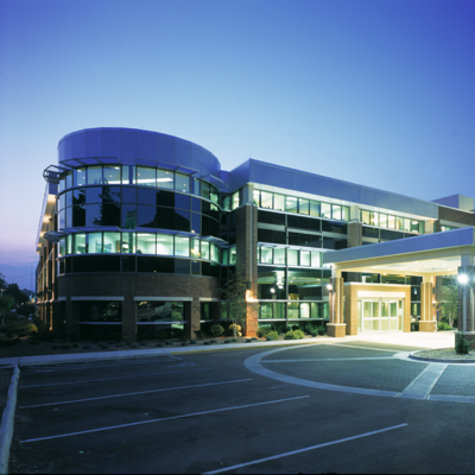
Carilion Clinic night view (SFCS photo).^

Radford University, working with Carilion Clinic and Jefferson College of Health Sciences in Roanoke will team to offer a doctorate degree in physical therapy next year.

The DPT program will be located in Carilion Roanoke Community Hospital, sharing space, services and resources with Jefferson College of Health Sciences.

Carilion Clinic Chief Operating Officer Nancy Agee says, "We have a long history with RU, working together in health professions education. We’re pleased to be able to jointly bring this new doctoral program to the Roanoke Valley. The three-year program will admit 25 students per year for a total of 75 students at full enrollment.

"It will not only help us meet an important patient need, [but] it sets the stage for future opportunities to collaborate. With these doctoral students joining our JCHS Nursing and Health students, Virginia Tech Carilion and University of Virginia medical students, Carilion Clinic Medical Education residents and fellows, we are building a remarkable center for health professions and medical education here in the Roanoke Valley."